Vivo's New Vertically Rollable Smartphone Leaks in Patent
Published: March 2026
A newly spotted Vivo PATENT, thanks to our collaboration with David from @xleaks7, gives us an early look at what could be the brand's next big smartphone: a vertically rollable phone.
Instead of folding like a Flip or opening like a Fold, this one expands upward.
In normal mode, it looks like a regular slim smartphone. But when extended, the screen becomes much taller, giving users more room for content without making the phone wider.
Let's dive deeper into it.
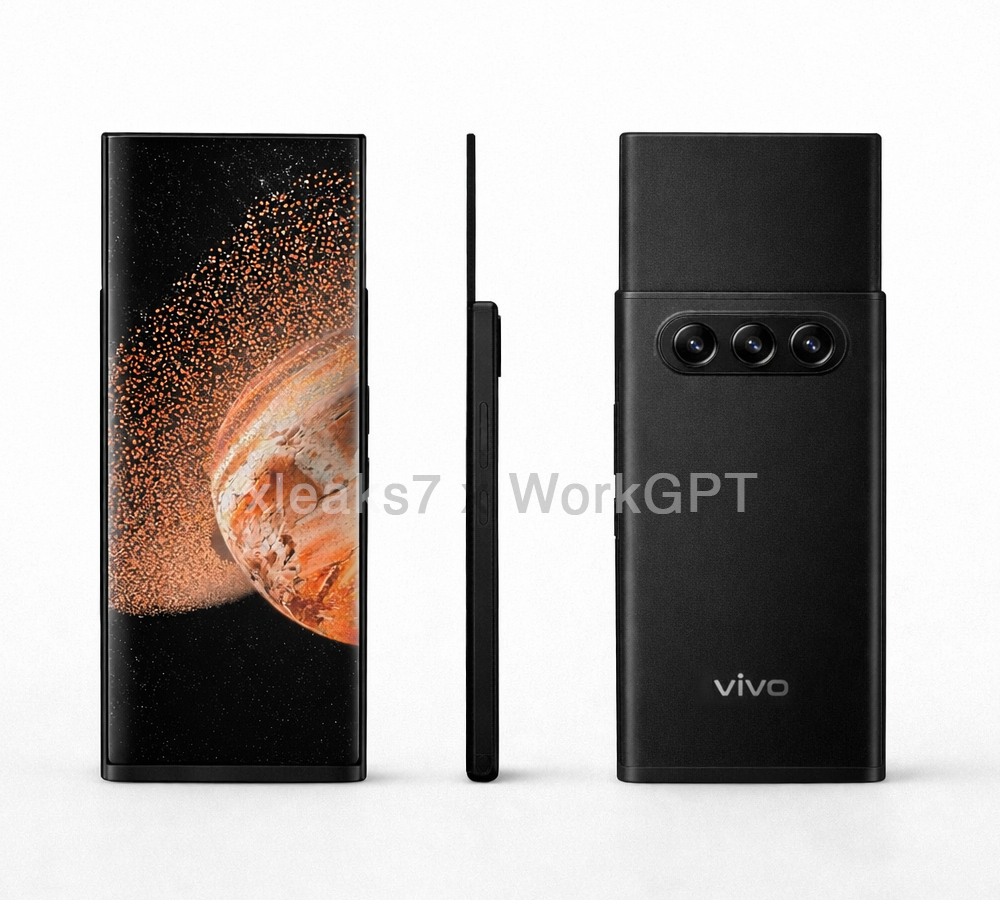
The Design
From the patent drawings, Vivo's phone looks tall, narrow, and very clean.
The front is mostly all screen, with a slim, straight-sided silhouette.
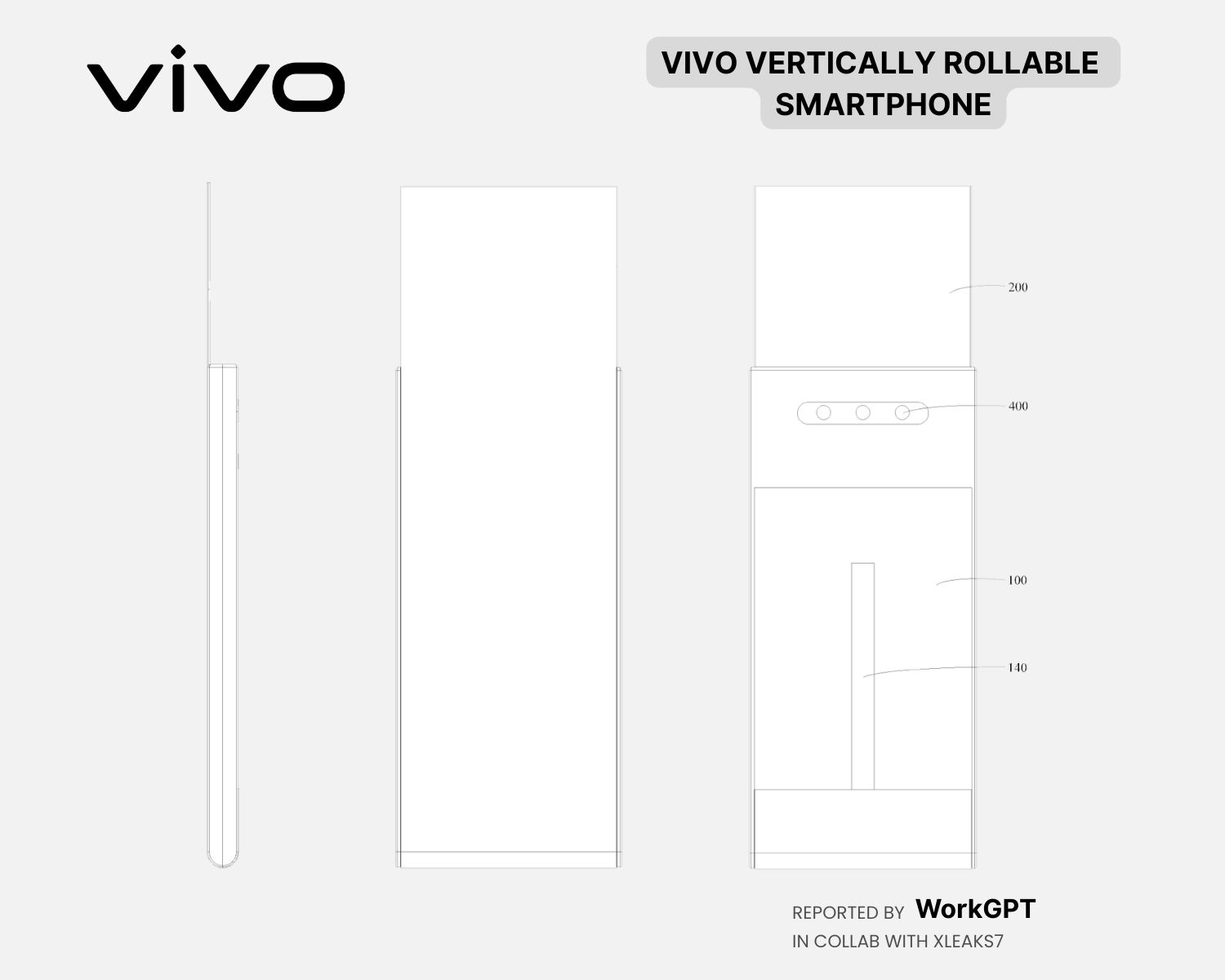
In the extended state, the display grows vertically, which makes the device look like a stretched flagship instead of a phone-tablet hybrid.
The back is just as minimal. There is a horizontal triple-camera bar near the top, while the rest of the rear panel stays simple.
One of the more interesting details is the long vertical section on the back shown in the patent views, which seems tied to the internal sliding structure rather than decoration.
The side profile tells the bigger story. The phone looks thicker than a normal slab device, which makes sense because part of the flexible display and the rolling mechanism have to live inside the body.
The drawings also suggest a curved internal path at the bottom, hinting at how the panel wraps and moves through the chassis.
Why Rollables?
The big promise of rollables has always been simple: more screen without the visual baggage of a fold line across the middle.
That is exactly why companies keep coming back to the idea.
OPPO's concept specifically pushed the “no hard fold” angle, and that remains one of the clearest arguments for this category.
If brands can make the mechanism durable enough and the price less ridiculous, rollables could eventually feel more elegant than today's foldables.
The hard part, of course, is getting from concept to retail product.
LG is the cautionary tale. Samsung is the favorite. Vivo is the new name making sure it is part of the conversation.
AI Features
This kind of device feels like a natural fit for adaptive AI experiences.
In a compact state, AI could handle fast, glanceable tasks like notification summaries, suggested replies, voice queries, and smart camera enhancements.
In the expanded mode, the taller display could become far more useful for document summaries, live translation, writing assistance, and split-screen productivity.
That is the bigger opportunity here.
On a rollable phone, AI would not just be another software layer, it could become the reason the screen expands at all.
NOTE TO EDITORS: The text and visuals of this article are the intellectual property of WorkGPT.com. If you want to share the content, please give a proper clickable credit. Thanks for understanding.
Cost-Effective Samsung Galaxy Z Flip with Circular Samsung Watch-Like Screen Leaked in Patent
Published: March 2026
A newly spotted Samsung PATENT, revealed in our collaboration with David from @xleaks7, offers an early look at what could be a more cost-effective flip-style foldable phone.
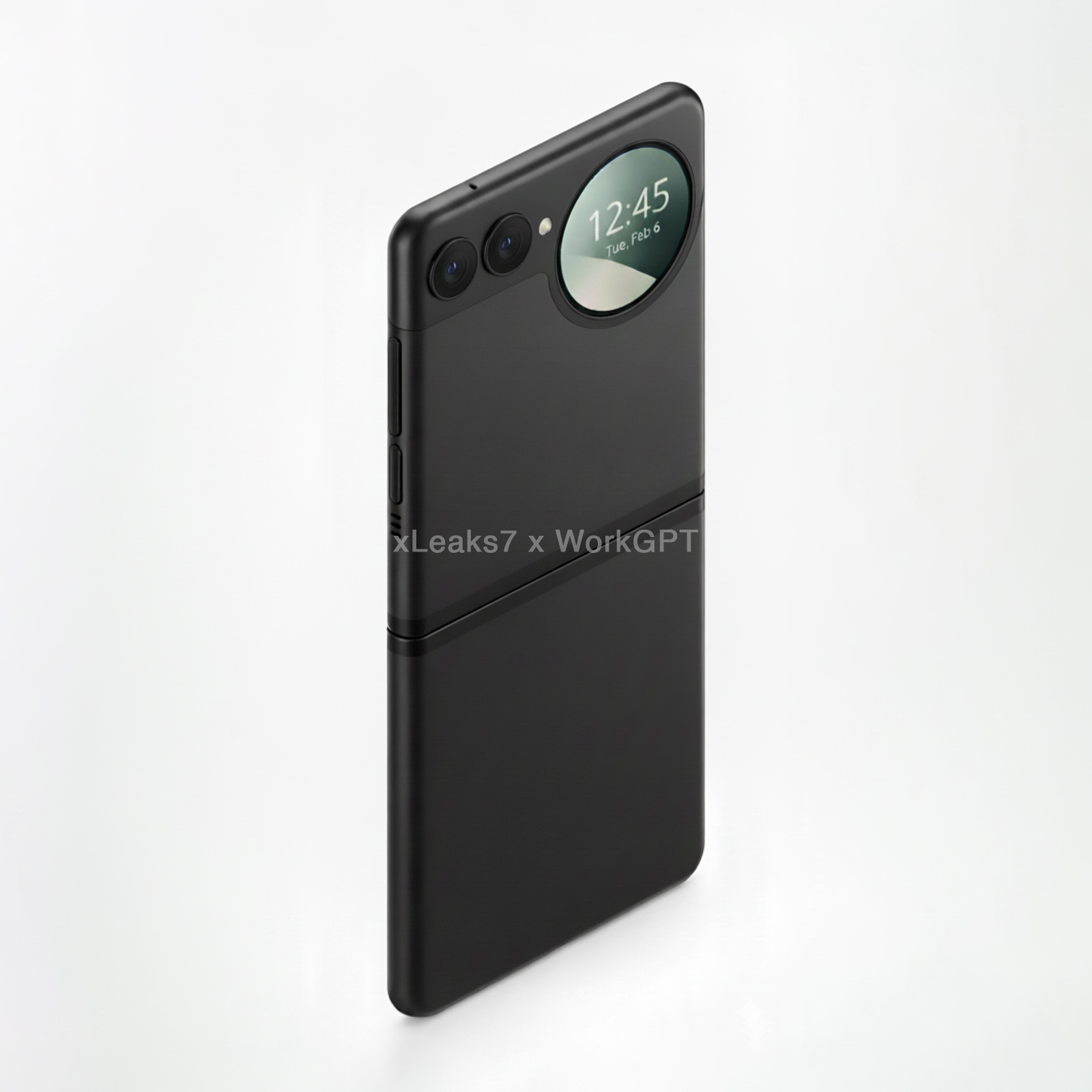
The standout detail is a large circular outer display on the back, a design choice that instantly brings Samsung's Galaxy Watch to mind.
Based on the patent drawings and our renders, Samsung seems to be exploring a simpler way to make foldables more affordable: cutting back the size and complexity of the outer screen.
That matters because $899 is still too high for many buyers, especially when Motorola already offers a $699 Razr. A smaller circular outer screen could be one way to cut costs and close that gap.
Instead of a larger rectangular cover screen, this design points to a more compact circular display that could help lower costs while still giving the phone a distinct look.
The Design
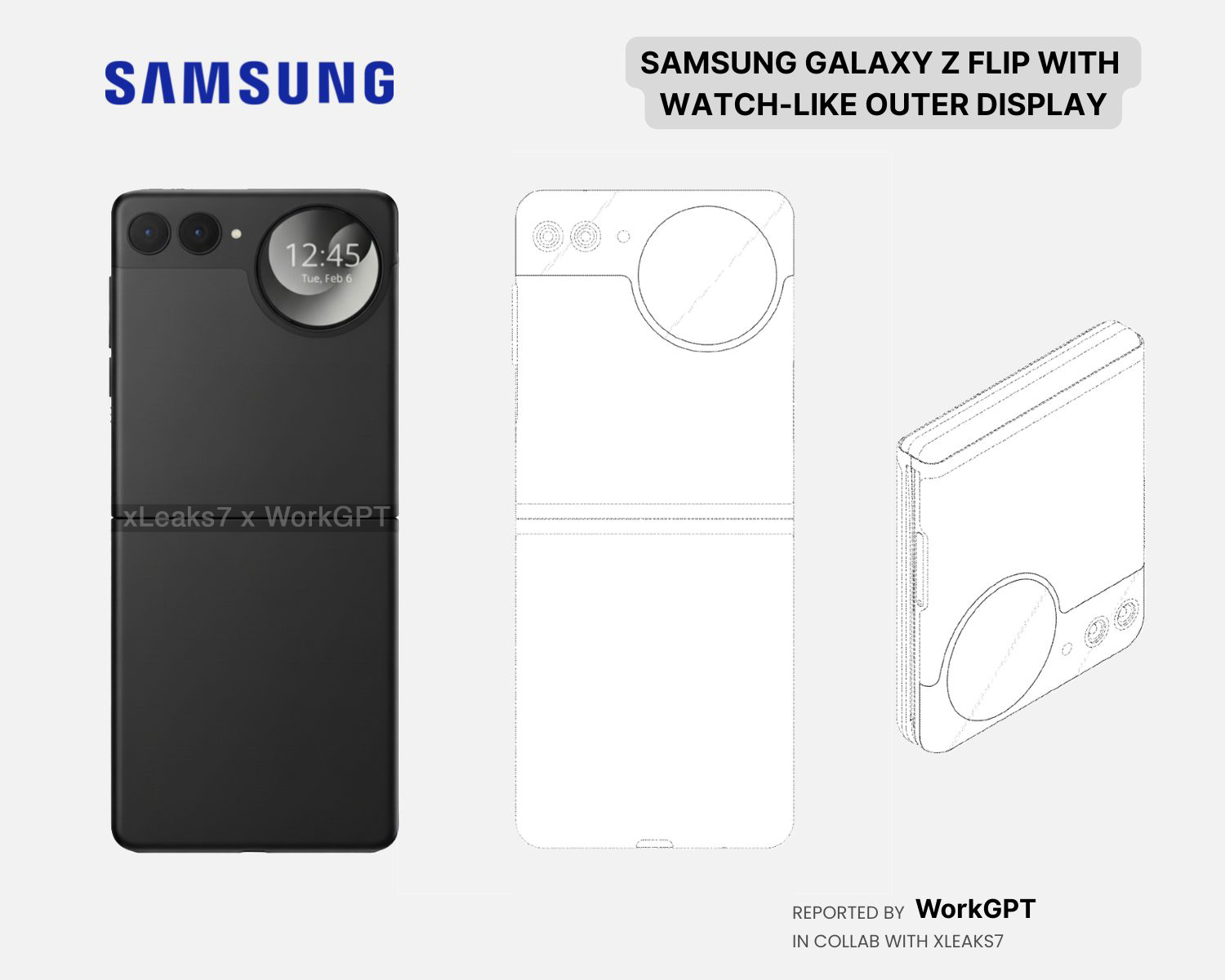
The patent drawings show a classic clamshell foldable phone with a simple, compact layout.
On the outside, the most noticeable element is the large circular cover display placed on the upper half of the back panel. Next to it, Samsung appears to place two rear cameras and an LED flash.
When unfolded, the device looks like a standard tall smartphone with a full-size inner display.
The hinge sits across the middle of the frame, allowing the phone to fold in half horizontally.
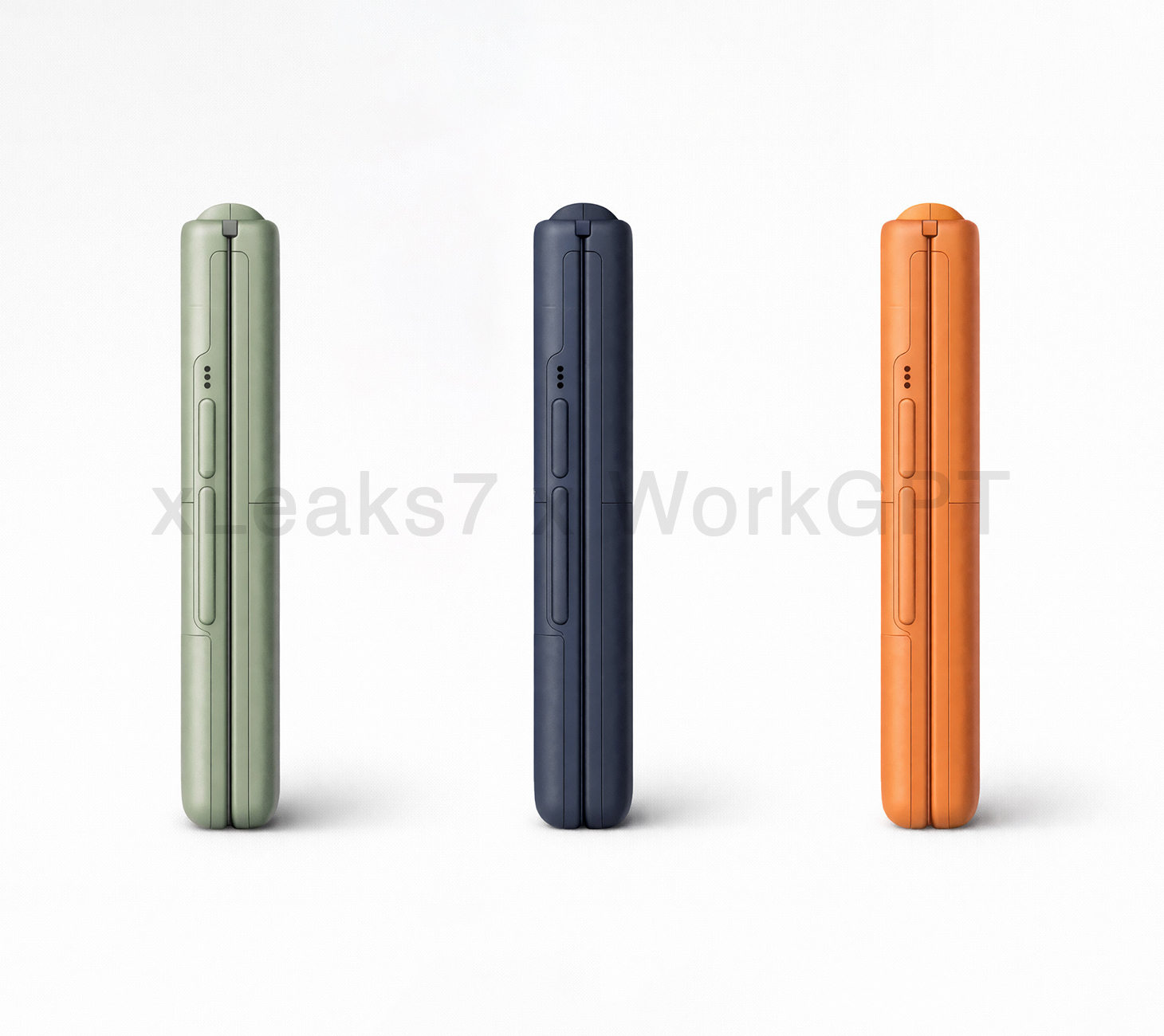
From the side views, the body appears relatively slim in the open position.
The frame itself looks rounded rather than flat, which could make the phone more comfortable to hold compared to boxier designs.
The side buttons are visible on the edge, likely including the volume rocker and power button.
Overall, the design shown in both the patent drawings and the renders suggests Samsung is aiming for a cleaner and simpler flip phone, with the circular outer screen as the main visual difference.
AI Features
The patent does not confirm AI functions, but this type of device would likely use AI in a limited and practical way.
A circular outer screen makes sense for short AI actions, not full app use. Samsung could use it for message summaries, suggested replies, reminders, voice assistant results, and quick travel or calendar info.
Camera AI is also an easy fit. Since flip phones are often used for selfies and hands-free shots, Samsung could rely on AI for framing, low-light cleanup, and quick image processing.
The important point is that this would not need to be “big AI.” It would just need useful AI. On a more affordable foldable, that is probably the smarter approach anyway.
The Pricing
The Galaxy Z Flip7 FE launched at $899 in the US, while Motorola's standard Razr starts at $699, which is a much easier entry point for mainstream buyers.
That is why this design stands out. A smaller circular outer screen could help Samsung lower component costs, simplify the phone's layout, and push a future model below FE pricing.
There is no confirmed price yet, but this kind of design makes the most sense if Samsung wants to move closer to the $699–$799 range, where Motorola is already putting pressure on the market.
That is the real angle here: not just a different look, but a possible attempt to make Samsung's flip phones feel more financially realistic for normal buyers.
NOTE TO EDITORS: The text and visuals of this article are the intellectual property of WorkGPT.com. If you want to share the content, please give a proper clickable credit. Thanks for understanding.
Google May Let Sites and Apps Disable Screen-Sharing Specific Content
Published: March 2026
Screen sharing is one of those features we use every day, and also one of the easiest ways to leak something you never meant to show.
A single tab can include private messages, customer data, account numbers, or internal dashboards.
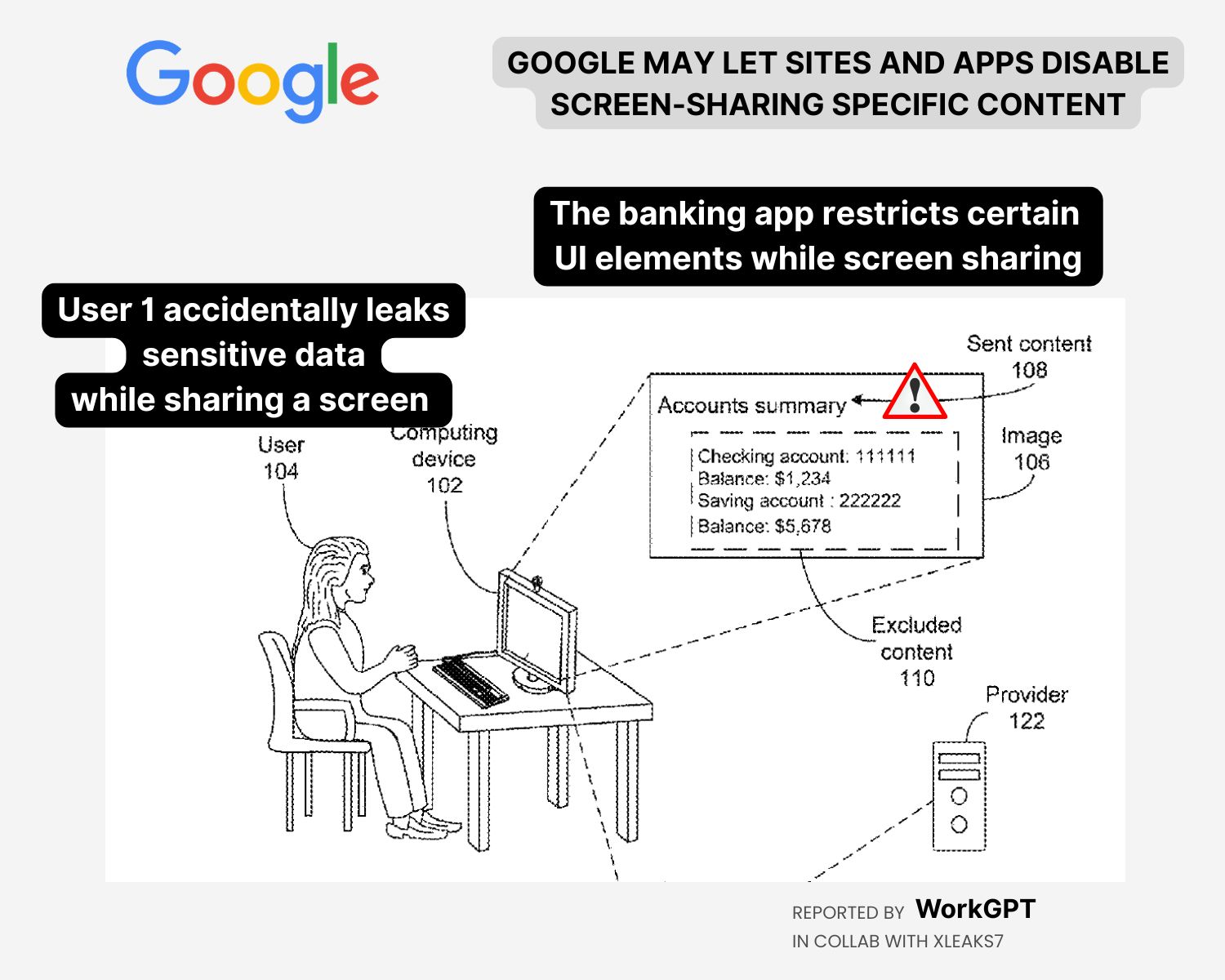
Thanks to our collab with David from @xleaks7, we spotted a PATENT that describes a way to make screen sharing smarter by letting parts of what you see on-screen be treated differently when you share your screen.
The interesting twist is who gets to decide.
The patent's approach allows the content provider (the website or app) to mark certain parts as shareable or not shareable, and the screen-sharing system follows those rules.
The Problem
Today, screen sharing is mostly all-or-nothing. You share a full screen, a window, or a tab. If something sensitive appears inside it, it is on you to notice and hide it in time.
The patent targets that exact moment of risk: accidental exposure during screen share.
It aims to prevent sensitive UI areas from being captured and transmitted, even if they are visible on the presenter's device.
The Solution
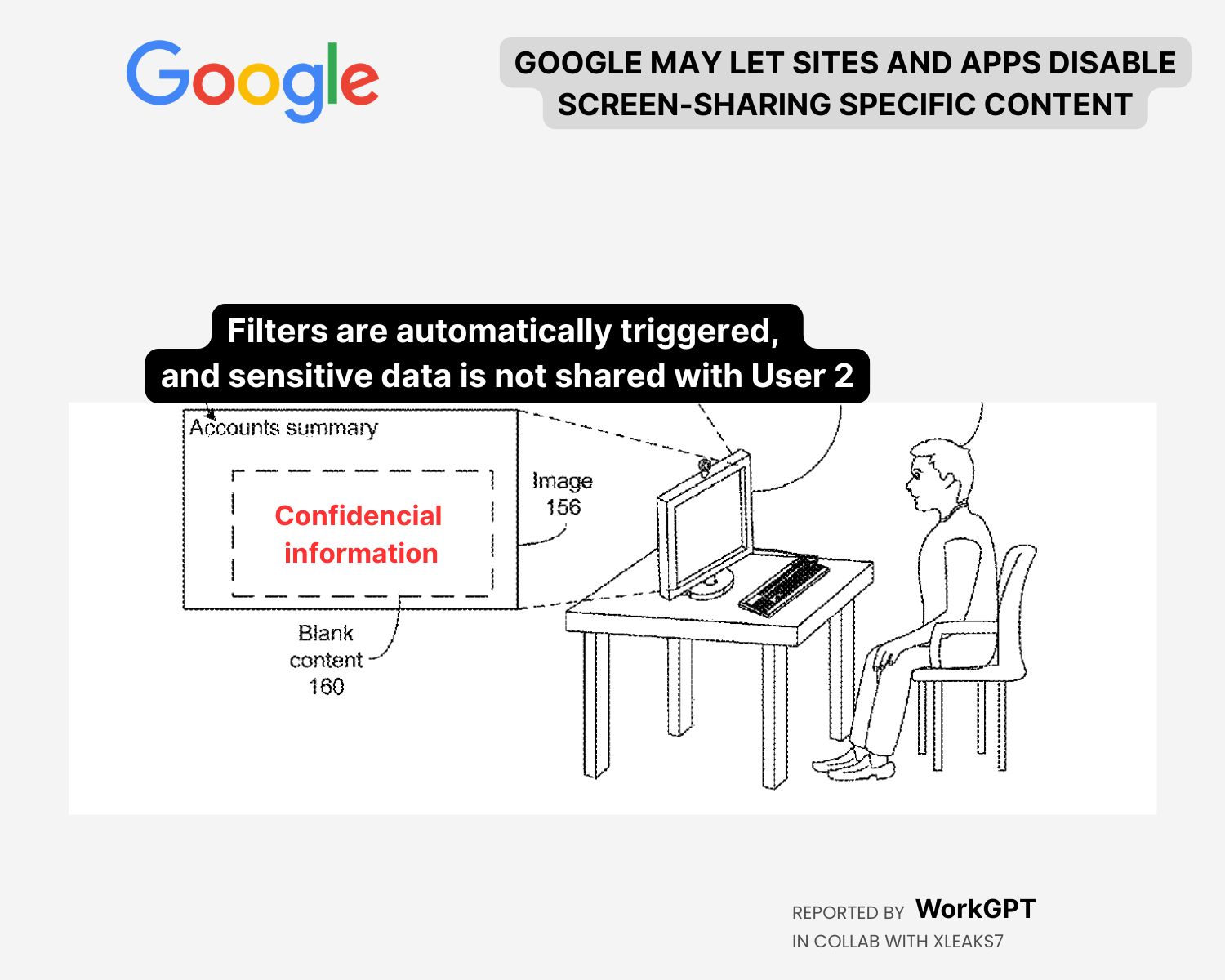
Google's idea is basically a “no-share tag” for UI.
Not a warning. Not “be careful what you show”. A real rule that a website or app can attach to specific parts of what you see, so those parts simply do not show up for anyone watching your screen share.
That means a bank could let you screenshare the support page but automatically hide your balance and account numbers. A workplace dashboard could hide customer names while still showing charts. A messaging app could blank your DMs while leaving the rest of the window visible.
If the content provider can mark parts of a page as “not shareable”, they can also block you from sharing things they do not want shown. Think premium content, pricing tables, internal analytics, competitor comparisons, or any section a platform would rather keep off camera.
It is a privacy feature that can also act like DRM for screen sharing.
Key Points
- Websites/apps can mark specific UI as “not shareable”
- Screen sharing obeys those rules automatically
- Blocked areas can be hidden or replaced with placeholders
- Only the sensitive section disappears, not the whole screen
- Works for live calls, not just screenshots
- Big privacy win for users (banking, health, work tools)
- Potential “screen share censorship” if platforms abuse it
- Could become “DRM for screen sharing” for paywalled or sensitive pages
NOTE TO EDITORS: The text and visuals of this article are the intellectual property of WorkGPT.com. If you want to share the content, please give a proper clickable credit. Thanks for understanding.
Google Will Replace Poor Sites With AI Landing Pages
Published: February 2026
Google might be seriously considering changing where you land after tapping certain search results.
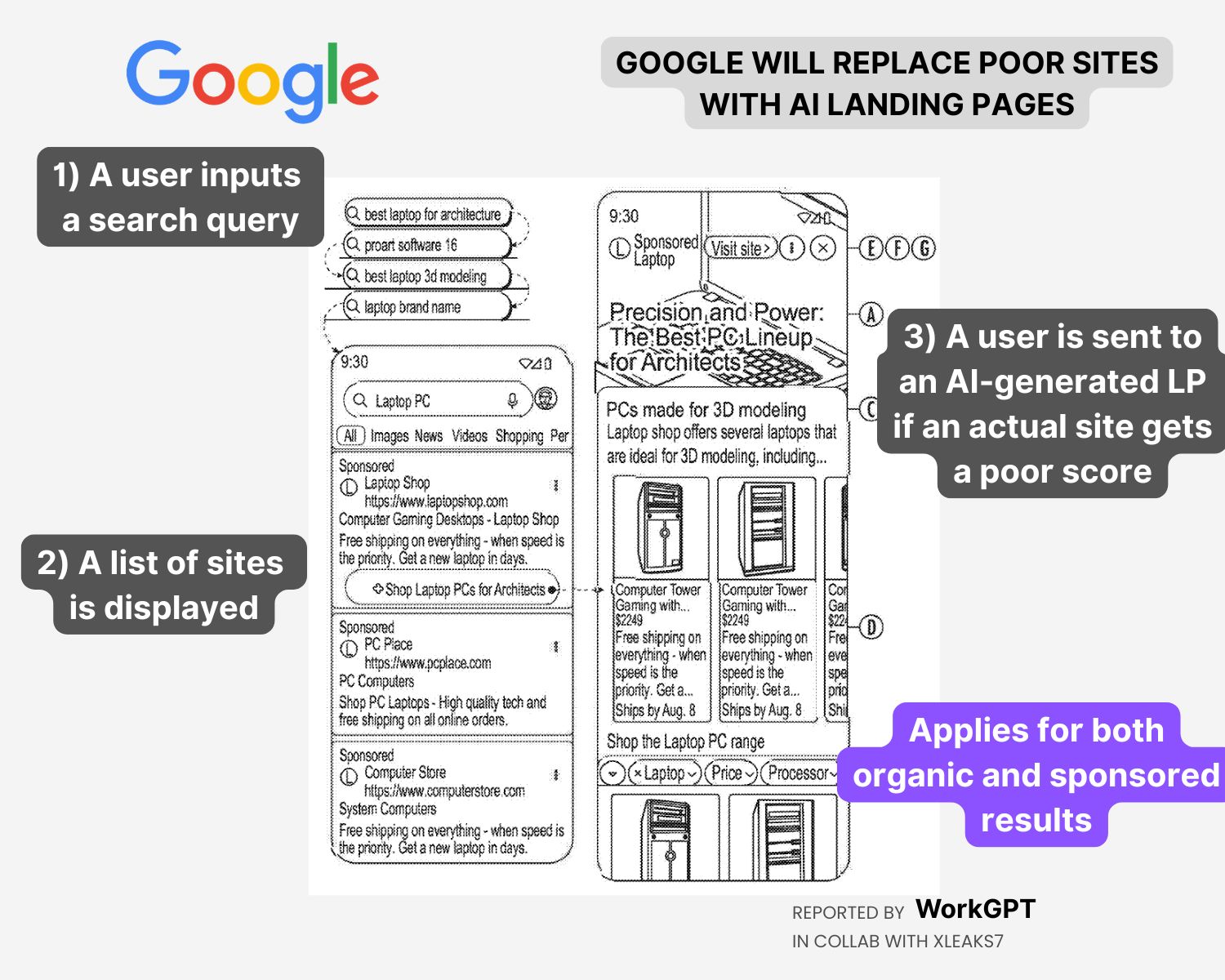
This PATENT, thanks to our collab with David from @xleaks7, describes a search feature that can add a special link inside normal search results.
When a user taps it, he's taken to an AI-generated landing page that is built for their query and can be tailored using context from their account.
Instead of forcing people to bounce between multiple web pages, the system tries to give a more direct, organized, and action-oriented experience, especially when the usual landing pages are not great.
The Problem
Search results often point to landing pages that are hard to use.
The patent specifically talks about landing pages being difficult to navigate, which can hurt the user experience, for example when someone struggles to find what they need to buy because the page is not designed well for usability and engagement.
It also frames the issue in terms of performance outcomes.
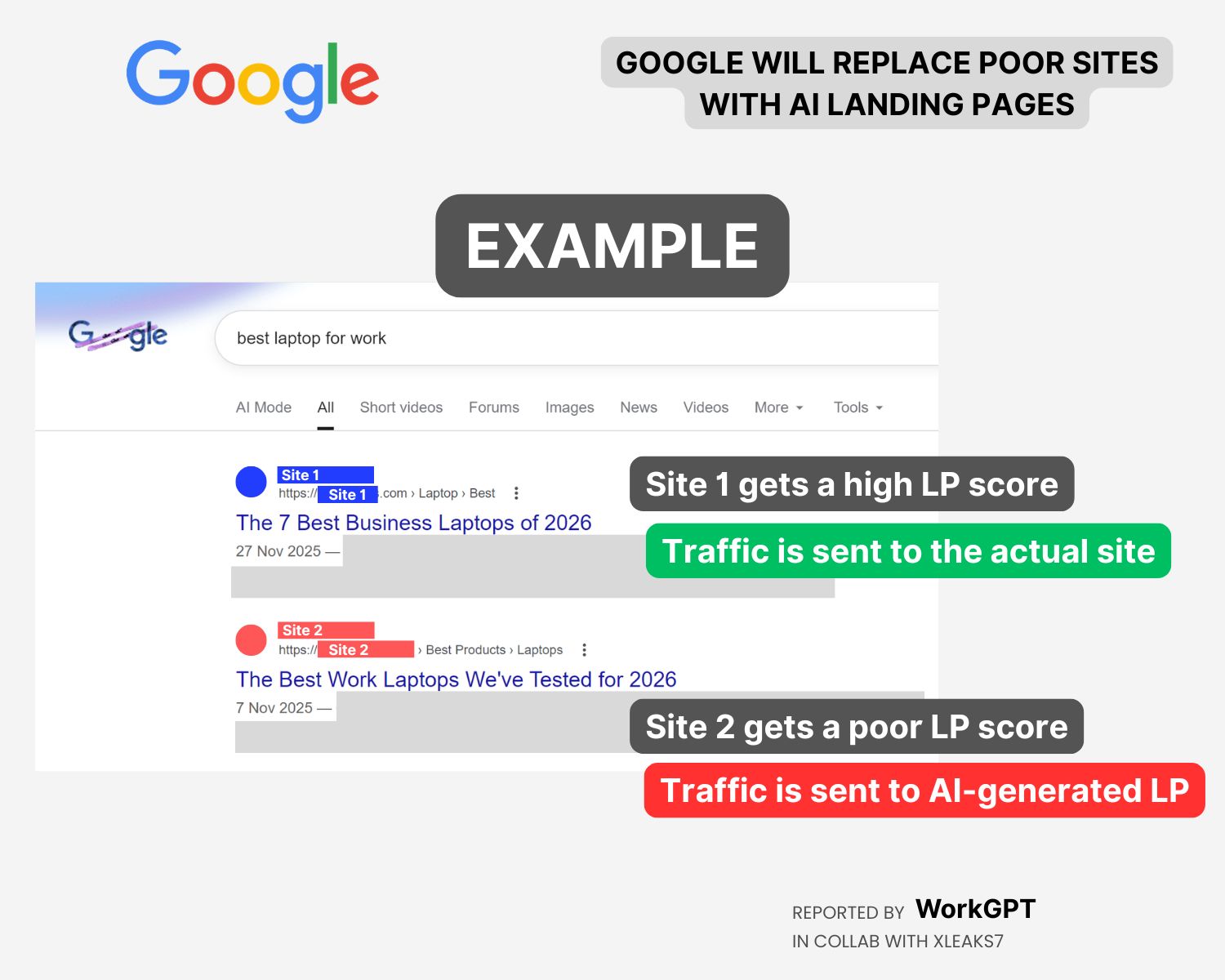
The system can evaluate landing pages using signals like conversion rate, bounce rate, and click-through rate, and treat poor-performing pages as candidates for an AI-generated alternative.
How Does It Work?
At the center is the idea of generating an “AI-generated page” associated with a specific organization shown in the search results.
The system processes the user query plus contextual information, including previous queries, and uses a machine-learned model to generate the page and present it in the user's account interface.
Whether the AI option shows up can depend on a computed “landing page score” and a threshold.
When the score exceeds the threshold, the search results can include a navigation link to the AI-generated page.
The patent even gives an example condition: the score can exceed the threshold when the landing page lacks useful product filtering.
AI-generated landing pages can appear for both organic and sponsored search results.
Key Features
- One-tap AI page in search: A link in the results opens an AI-made landing page for that brand/site
- Personalized to you: The AI page can use your context, including what you searched before
- Shown only when it helps: A score/threshold decides whether the AI link appears
- Uses real performance signals: Things like clicks, bounces, and conversions can influence that score
- Can include a chatbot: An AI chat helper can guide you to the right option
- May also show in ads: The same AI link can appear inside sponsored placements
NOTE TO EDITORS: The text and visuals of this article are the intellectual property of WorkGPT.com. If you want to share the content, please give a proper clickable credit. Thanks for understanding.
All the best AI tools.
One place.
All the most useful AI tools, together. No more scattered subscriptions or jumping between apps. Just one place for your whole team.
Something good is on the way. Stay tuned.
Everything in one place
Writing, research, images, code—all the tools your team actually uses, without managing a dozen different subscriptions.
Built for teams
Share access across your whole team with one simple subscription. No more juggling individual accounts and expenses.
Private by default
Your data stays yours. We don't train on your stuff, and we pick partners who feel the same way.